Quick Summary
Additional Context
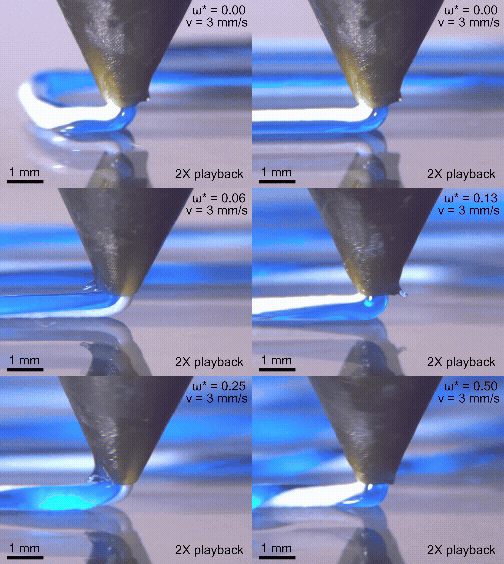
Researchers at Harvard John A. Paulson School of Engineering and Applied Sciences (SEAS) have developed a new way to 3D print materials that can move on their own, bending, twisting, and contracting without motors or traditional mechanical systems. The work, recently published in Proceedings of the National Academy of Sciences, points to a future where motion is built directly into materials.
The research comes from the lab of Jennifer Lewis, a pioneer in 3D printing and soft materials. Her team created what are essentially artificial muscles. 3D printed filaments and structures made from two materials that react differently to heat, causing them to change shape in predictable ways. So instead of assembling moving parts, the team prints motion into the material itself, working alongside f