Quick Summary
Additional Context
Fitting a motor and battery into a robot shrinks fast as the robot gets smaller, and at microgram scales it becomes close to impossible. Researchers at the Swiss Federal Institute of Technology in Lausanne (EPFL) have proposed a way around that limit: powering small robots with sound instead of onboard mechanical components, opening a path to machines at sizes where conventional propulsion simply does not fit.
How Acoustic Resonance Generates Thrust
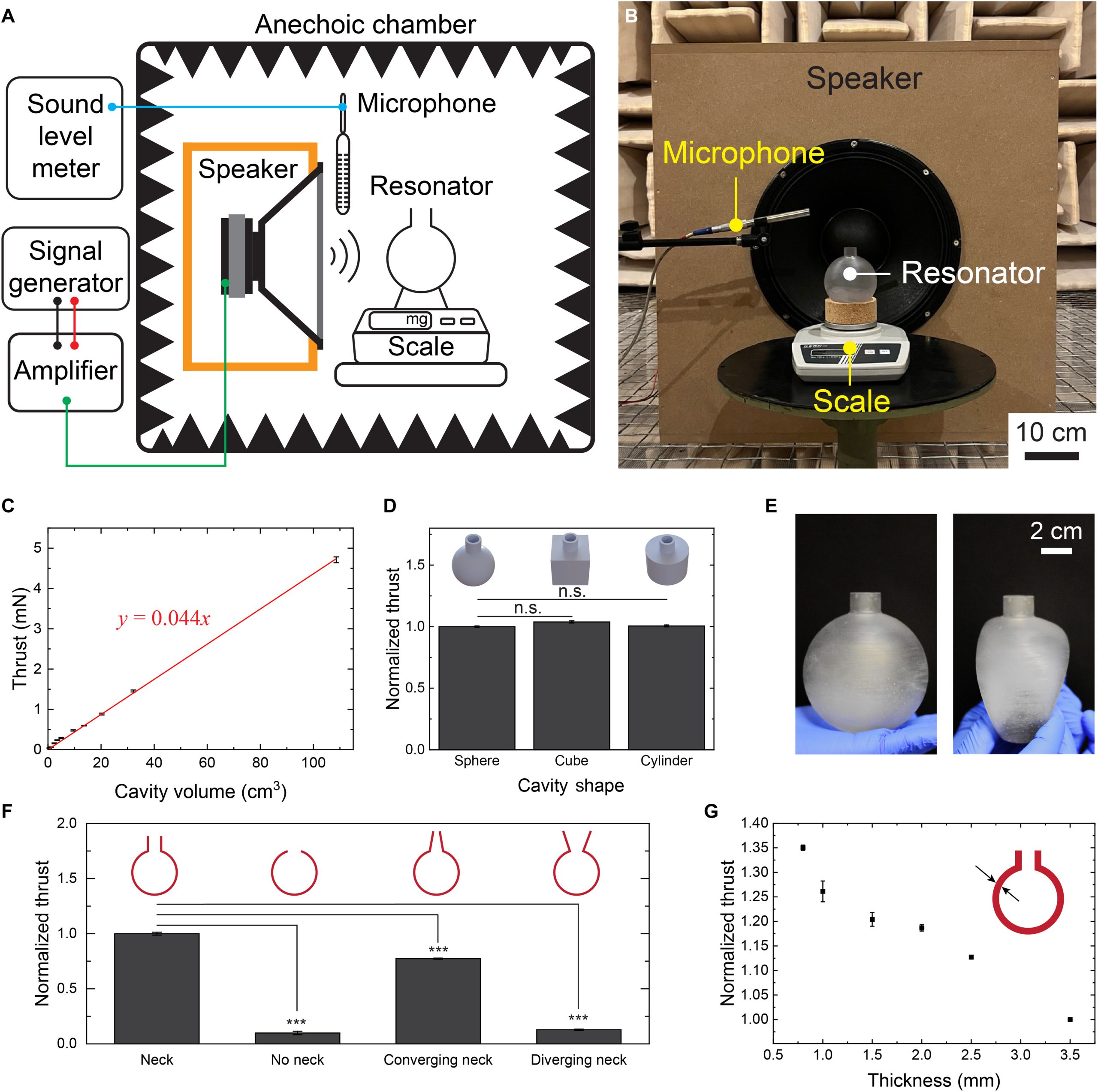
The approach relies on Helmholtz resonance, the effect that produces a tone when air is blown across the neck of a bottle. The team 3D printed hollow cavities with narrow necks, tuned so that sound at a specific frequency causes the air inside to oscillate strongly enough to generate a directional jet, and with it, usable thrust. Resonators w