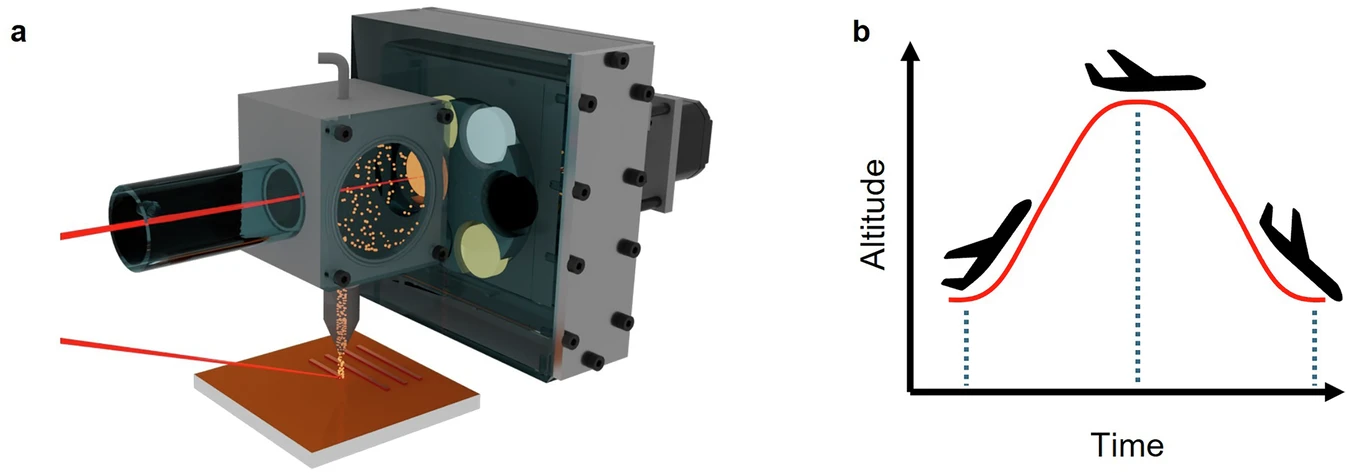
Quick Summary
Additional Context
Researchers from Auburn University and NASA Marshall Space Flight Center have demonstrated that conductive metal structures can be printed in microgravity without liquid inks, using a compact, self-contained system that generates, deposits, and sinters metal nanoparticles on demand. The work, published in npj Advanced Manufacturing, presents results from a two-day parabolic flight campaign and represents a step toward on-demand electronics fabrication during long-duration space missions.
A Dry, Inkless Approach
The technology at the center of the study is a dry additive nanomanufacturing (Dry ANM) platform developed at Auburn University. Rather than relying on pre-made inks or powders, the system uses laser ablation to vaporize solid silver or copper targets, condenses the resulting vapo